
What if the cleanup steps that seem fastest are the ones that make water damage harder to fix? After a leak or flood, it’s natural to start moving belongings and drying visible water. But water damage cleanup mistakes can put people at risk, damage belongings, or leave moisture hidden behind walls and under floors.
Before you enter, make sure the area is safe. Water near electrical systems or from an uncertain source can make do-it-yourself cleanup unsafe. Once conditions allow, photograph the damage before moving or discarding items. A dry-looking surface doesn’t prove the area underneath is dry.
This guide explains what to avoid, what to protect, and what to record after water damage. You’ll learn how to limit further damage without overlooking hidden moisture or losing track of important details for an insurance claim. We’ll also explain when professional mitigation makes sense, especially if the water’s source or spread is unclear. Droplet Restoration provides water damage mitigation and restoration for homes and businesses in Vancouver and nearby southwest Washington communities.
Key Takeaways
- Learn which water damage cleanup mistakes can turn a manageable cleanup into a larger problem.
- Understand why household vacuums, fans, and surface disinfectants may not address every water loss.
- Follow a safer response sequence to protect people, preserve belongings, and document damage.
- Recognize signs that water may have reached concealed areas that need a more thorough assessment.
- See how professional mitigation can support water damage recovery for homes and businesses in southwest Washington.
Water Damage Cleanup Mistakes That Can Make the Situation Worse
Finding water in your home or business can make every minute feel urgent. Take a breath, then focus on protecting people and limiting further damage. Common water damage cleanup mistakes include entering an unsafe area, delaying action, drying only what you can see, and failing to document what happened.
There’s no single cleanup plan for every loss. The right response depends on the water source, how far it spread, which materials are affected, and whether immediate hazards are present. A small visible puddle may be only part of the problem. This overview of water damage explains why causes and affected materials matter, but your first decisions should be practical and safety-focused.
Prioritize safety, stop the source if it’s safe, document the damage, and begin appropriate mitigation.
Mistake: starting cleanup before checking for hazards
Don’t rush into standing water or a room that may be structurally unstable. Water near electrical systems can create a serious hazard, and damage to floors, ceilings, or walls may make an area unsafe to enter. Keep children, visitors, employees, and pets away until immediate hazards have been assessed. Don’t handle electrical equipment or try to manage water that may be contaminated. If you can’t tell whether entry is safe, stay out and get qualified help to assess the situation.
Consider the source, too. Water from a supply line, a leaking appliance, or an outdoor event may require different precautions. Don’t assume water is safe to touch simply because it looks clear. If the source is still active, address it only if you can do so without entering a hazardous area or putting yourself at risk.
Mistake: treating visible water as the whole problem
Mopping or extracting a puddle removes surface water, but it doesn’t show how far moisture has traveled. Water can spread beneath flooring, behind baseboards, into walls, or into nearby belongings. Carpet, padding, drywall, and wood may hold moisture even after the surface looks dry.
A dry-looking floor or wall isn’t proof that the affected area is fully dry. Note where water appeared and where it may have moved, including adjoining rooms and spaces below the leak. Don’t put wet items back into storage or cover damp areas before their condition is understood. If water extends beyond what you can see, professional mitigation can help assess the damage and guide the next steps.
Don’t wait for everything to dry on its own. When it’s safe, document the damage before moving or discarding affected belongings. Photograph wet materials, damaged contents, and the apparent source, and note what you observe. Clear records preserve a useful account of the loss while a fuller assessment determines what needs attention.
Why Delays and Surface-Only Drying Can Leave Water Damage Behind
A quick wipe can make a room look better without resolving the moisture problem. Water can soak into porous materials and move into concealed spaces, where it may remain after the visible surface dries. The longer affected materials stay damp, the more complicated drying and recovery may become. Prompt assessment helps clarify what is wet and what needs attention, though it can’t guarantee that all damage will be prevented.
Visible cleanup removes what you can see; moisture assessment helps identify what the surface doesn’t show. The water source, affected materials, and extent of intrusion all influence what drying is needed. A towel may handle a small spill on a hard surface, but it can’t show whether water reached the flooring underneath or an adjoining wall.
How water can travel beyond the obvious wet spot
Water may spread along or beneath flooring, pass through gaps, or affect adjoining materials. In a multi-level home, a leak around a bathroom fixture could leave a stain on the ceiling below. The stain points to a possible pathway, but its visible size may not match the full area affected behind the ceiling or floor.
Look beyond the first wet spot without putting yourself at risk. Note nearby surfaces, rooms, and belongings that may have been exposed. Watch for dampness, discoloration, or a musty odor, but don’t treat the absence of these signs as proof that concealed materials are dry. A professional assessment can help determine where moisture traveled and whether further mitigation is needed.
Why waiting can complicate drying and recovery
When wet materials remain damp, drying may take more work and the scope of restoration may grow. Some materials absorb and hold moisture; others may be affected as water reaches seams, cavities, or layers beneath the surface. Persistent moisture can also create conditions where mold may develop. It isn’t certain to happen, but it’s one reason not to leave a water loss unassessed.
Waiting for a stain to disappear or a room to feel dry can prolong uncertainty. A fan or open window may move air across an exposed surface, but neither confirms that moisture trapped inside a material has been addressed. Drying needs vary, so don’t rely on one visual check or a fixed do-it-yourself routine. For flood-related cleanup precautions, the CDC flood cleanup safety guidance offers additional information on reducing risks during cleanup.
If you can’t tell how far water has traveled, a timely assessment can help define the affected area and guide next steps. For homes and businesses in Vancouver and nearby southwest Washington communities, professional water damage mitigation can help address moisture concerns before they become harder to manage. Learn more about the water damage restoration process, including how assessment, water removal, and moisture monitoring fit together.
Water Damage Cleanup Myths: What DIY Methods Can and Cannot Do
DIY cleanup can be reasonable for a small, clearly understood spill on a safe, nonporous surface. But household equipment and cleaning products can’t resolve every water loss. The water source, affected materials, spread, and safety conditions all matter. Understanding these limits helps you avoid water damage cleanup mistakes that leave moisture or hazards unaddressed.
Use this myth-versus-reality guide to assess common approaches. If you can’t establish what got wet or whether the area is safe, pause and arrange a professional assessment instead of relying on a household method to address unknowns.
Myth: any wet-dry vacuum or fan can handle the cleanup
Reality: A vacuum may collect accessible water, and a fan may move air across exposed surfaces. Neither proves that affected materials are dry or reaches every concealed area. What’s appropriate depends on the water and extent of damage. Don’t use household equipment where electrical hazards may exist or where the water source raises contamination concerns.
Myth: disinfectant or paint can solve lingering moisture
Reality: A surface product doesn’t remove moisture inside a material. Paint can cover a stain without resolving its source, while surface disinfectant doesn’t establish that damp flooring, wall materials, or belongings have been addressed. Don’t conceal a stain until you understand its cause and the extent of the affected area.
Myth: A household vacuum is suitable for any water. Reality: Using one may be inappropriate depending on the equipment, water source, and hazards. Don’t bring it into an unsafe or potentially contaminated area.
Myth: Fans prove a room is dry. Reality: Air movement may help exposed surfaces, but it can’t confirm conditions inside flooring, walls, or other materials.
Myth: Disinfectant fixes all water damage. Reality: Cleaning a surface isn’t the same as removing moisture or assessing what lies beneath it.
Myth: Paint makes a water stain go away. Reality: It may hide the mark, but the stain’s source and any remaining moisture still need attention.
Simple cleanup has limits, but it isn’t always off the table. If a small amount of clean water has affected a hard surface and there’s no safety concern, removing the water and cleaning the surface may be a sensible first step. Stop if water has spread into adjacent rooms, reached porous materials, or come from a source you can’t confidently identify. Don’t risk entering an unsafe area or operating equipment near possible electrical hazards.
For more extensive or uncertain damage, professional mitigation can assess the affected area and guide drying. Looking beyond what appears wet helps determine whether DIY actions are appropriate or the situation needs a more thorough response.
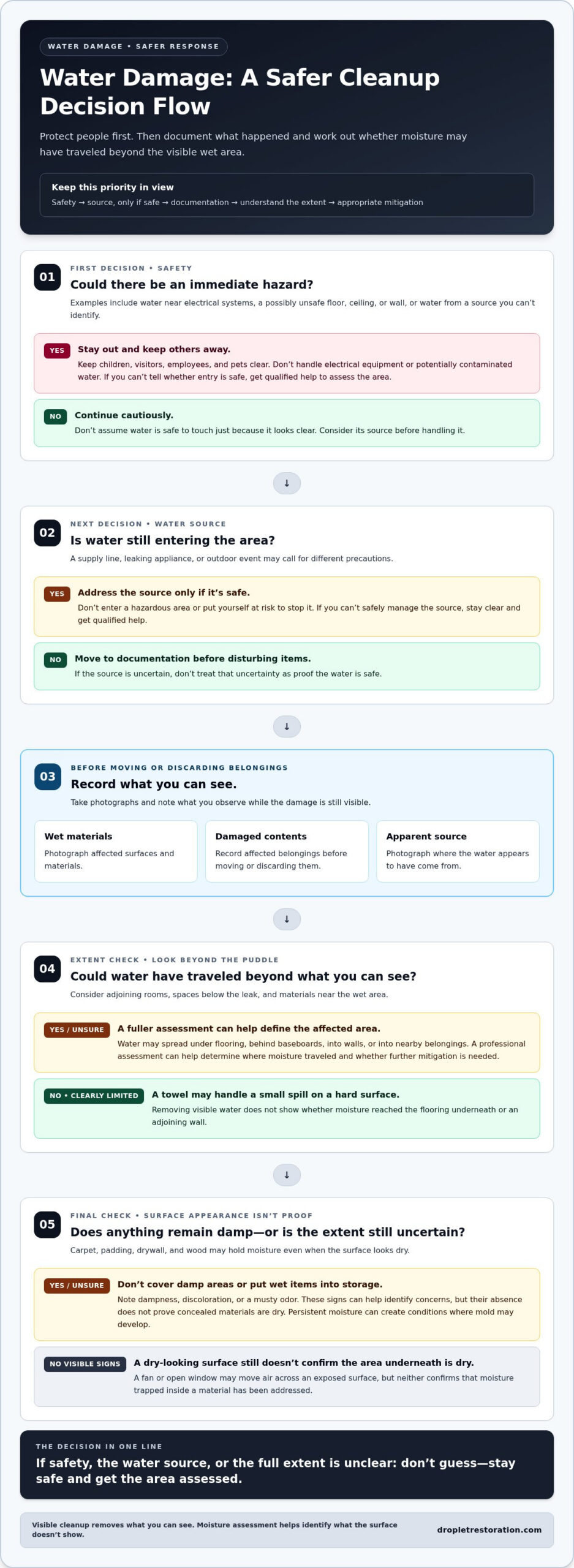
What to Do Instead: A Safer Sequence After Water Damage
A clear sequence helps you respond without creating new risks. Protect people first, address the source only if it’s safe, document what happened, then assess the cleanup. You don’t need to solve everything at once. Focus on the next safe, useful action.
- Protect people. Keep children, pets, employees, and visitors away from affected areas if you suspect electrical hazards, structural damage, or unsafe water. Don’t enter to retrieve belongings if doing so could put anyone at risk.
- Address the source only if safe. If you can stop the water without entering a hazardous area or handling unsafe equipment, do so. Otherwise, leave it to someone qualified to address the hazard.
- Document the damage. When it’s safe, photograph or record affected rooms, visible water, damaged materials, and belongings before moving or discarding them.
- Assess the cleanup. Consider the source, how far the water reached, and whether it may have affected materials you can’t see. Choose simple cleanup only when the situation is limited and safe to manage.
Document damage without delaying urgent safety measures
Take clear photos or video from different angles. Capture the overall room, close views of visible damage, and affected belongings. Note when you discovered the water, which areas appear affected, and any changes you observe. Keep the records together so they’re easy to refer to as cleanup progresses.
Safety comes first. Don’t enter an unsafe area or postpone necessary mitigation just to gather pictures. If water is still spreading, address immediate risks first and document what you can once it’s safe. When practical, keep damaged items in place long enough to record them, but don’t let documentation delay urgent action.
Where practical, keep undamaged belongings away from wet materials. Move items only if you can do so safely, and avoid carrying damp items through clean areas. This can limit the spread of water and make it easier to distinguish affected belongings in your notes and photos.
Know when a cleanup task is beyond a safe DIY response
Pause before taking on cleanup if water covers a wide area, the source is uncertain, moisture may be concealed, or an immediate hazard remains. These conditions can make it difficult to know what’s affected or whether entry is safe. Don’t treat a small visible mark as proof that the problem is small.
Some water damage cleanup mistakes happen when people keep working after the situation has outgrown a simple response. If the extent or safety conditions are unclear, professional assessment can help establish the scope and guide mitigation. A separate first-steps-after-flooding checklist can also help organize actions after a flood.
If you need help assessing water damage at your home or business in Vancouver or nearby southwest Washington communities, schedule a water damage inspection with Droplet Restoration.
When a Restoration Team Can Help Prevent More Cleanup Mistakes
Some water losses are difficult to judge from the surface. Water may have spread beyond the visible area, entered materials you can’t easily inspect, or come from a source that raises safety concerns. In these situations, professional mitigation can assess affected areas and guide recovery, reducing guesswork before an incomplete cleanup creates more problems.
What professional mitigation adds beyond surface cleanup
A restoration team can look beyond the obvious wet spot and evaluate the conditions affecting the property. The appropriate response depends on the water source, materials involved, affected area, and immediate hazards. That assessment clarifies where attention is needed and whether a simple cleanup is enough or the damage calls for a more thorough response.
Professional assessment is especially useful when the water’s extent is unclear, a room still feels damp after visible water is removed, or damage appears in more than one area. Rather than relying on appearance alone, mitigation helps establish a clearer picture of the loss and organize next steps. The response should fit the property and conditions on site, since not every incident needs the same approach.
Getting help can also ease the burden of coordinating recovery. Droplet Restoration works directly with all insurance providers to help streamline claims. Keep your photos and notes, and share what you observed about the water source and affected areas. Good records can help support the claims process, though coverage decisions depend on the policy and insurer.
Get local help in Vancouver and nearby communities
Droplet Restoration provides water damage mitigation and restoration for homes and businesses in Vancouver, Battle Ground, Camas, Ridgefield, La Center, Longview, Kelso, Woodland, Castle Rock, and Kalama. Its certified IICRC technicians handle water damage emergencies, with services available 24/7.
Droplet Restoration technicians respond within 90 minutes. If water damage is difficult to assess or manage safely, contact the team promptly to start the mitigation process.
If you’re unsure whether the affected area is safe, how far moisture has spread, or whether your cleanup has reached the materials beneath the surface, don’t guess. Droplet Restoration can help assess the damage and plan the next steps. A calm, informed response can help you move forward without taking unnecessary risks or overlooking areas that need attention.
Choose a Clear Next Step and Move Forward
Water damage can leave you weighing several questions at once: Is it safe to enter? Has moisture reached beyond what’s visible? Is the cleanup you’ve started enough? You don’t need to answer every question alone. If uncertainty remains, make your next step getting a clearer assessment rather than continuing to guess.
That choice can help you avoid water damage cleanup mistakes driven by urgency, such as treating a hidden problem as resolved or continuing in an area that may not be safe. Focus first on protecting people and giving the damage an appropriate response. Recovery can move forward one informed decision at a time.
Droplet Restoration provides water damage restoration support, with certified IICRC technicians and direct work with insurance providers. Emergency restoration services are available 24/7, and technicians respond within 90 minutes.
Take the next step with a team that can help you assess the damage. Get help with water damage cleanup from Droplet Restoration and move toward recovery with a clearer plan.
Frequently Asked Questions
Can I clean up water damage myself?
Yes, if the loss is small, the water source is known, and the area is safe. For example, you may be able to clean a little water from a hard kitchen floor after a contained spill. A leak that reaches cabinetry, flooring seams, or another room is different. If you’re unsure how far it spread, avoid water damage cleanup mistakes by getting the damage assessed before treating it as a simple surface cleanup.
Should I use a regular vacuum to remove water?
No. A standard household vacuum isn’t designed to collect water, and using it for that purpose can damage the appliance or create an electrical hazard. Don’t try it on a puddle, even if the water looks clean. If water is near outlets, appliances, cords, or other electrical equipment, stay clear and keep others away until the area is safe to assess.
Can I use bleach to clean up water damage?
Don’t use bleach as a catch-all solution for water damage. It won’t remove water held inside materials, and it may not be appropriate for every surface or item. Follow product label directions and never mix bleach with other cleaning products. If you’re dealing with a persistent stain, an unknown water source, or suspected mold, focus on identifying the underlying issue rather than masking it with a chemical treatment.
How soon can mold grow after water damage?
Mold can begin growing within 24 to 48 hours when conditions are suitable. The U.S. Environmental Protection Agency recommends drying water-damaged areas and items within that window to help prevent mold growth. That timing is a reason to act promptly, not a guarantee that mold will or won’t appear. If materials remain damp or you notice visible growth, arrange an appropriate assessment instead of relying on odor or appearance alone.
Should I throw away belongings affected by water?
Not necessarily. Whether an item can be kept depends on its material, the water source, and how extensively it was affected. Photograph belongings before moving or discarding them if it’s safe, and separate wet items from unaffected possessions where practical. Avoid using or storing items that remain damp until their condition is understood. If the item has sentimental or financial value, get guidance before making an irreversible decision.
Will homeowners insurance cover water damage cleanup?
Coverage depends on your policy, the cause of the damage, and the circumstances of the loss, so don’t assume cleanup will automatically be covered or excluded. Review your policy and report the damage to your insurer promptly. Keep photos, notes, and records of cleanup steps. Droplet Restoration works with homeowners and businesses in Vancouver, Battle Ground, Camas, Ridgefield, La Center, Longview, Kelso, Woodland, Castle Rock, and Kalama while they coordinate their claim.
